 EN

Magnetic Whiteboards for Offices
Please tell us about your company's advantages and characteristics.
2026/10/14
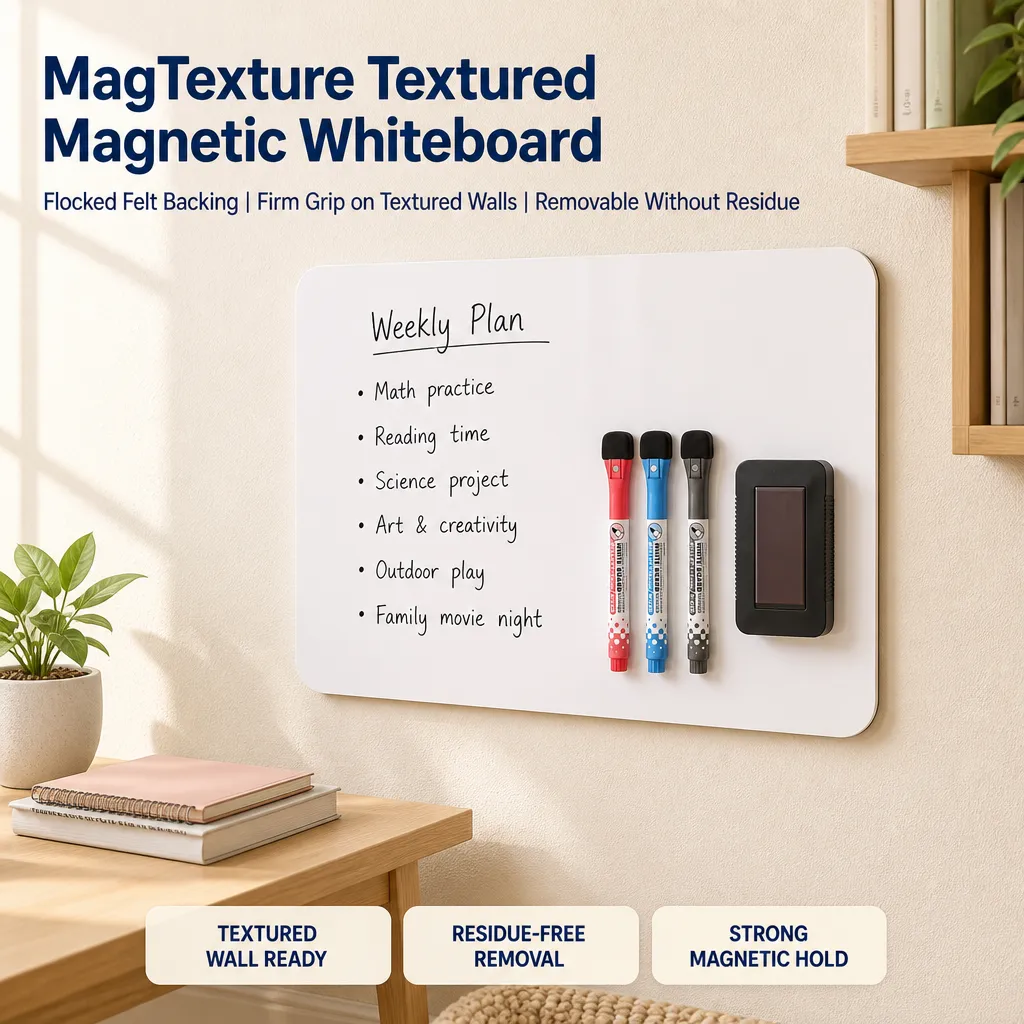
A dry erase board magnetic surface does two jobs at once: it gives people a reusable place to write and a steel-backed face for displaying notes, cards, schedules, or teaching aids with magnets. That combination sounds simple, but it changes how a room works. A classroom can keep lesson materials visible, an office can move tasks during a meeting, and a home can turn a wall or refrigerator into a planning zone.
When choosing a dry erase board magnetic option, start with the use pattern rather than the finish alone. A board that looks polished in a meeting room may not be the right answer for frequent classroom writing, a narrow corridor, or a refrigerator calendar. The right choice depends on the board format, face material, available wall, expected traffic, and the kind of magnets people will use.
A rigid dry erase board magnetic construction normally has a ferrous steel layer beneath its erasable writing face. That hidden layer lets ordinary magnets adhere to the front while users write with dry-erase markers. The writing surface, frame, backing, and mounting system all affect day-to-day results, so “magnetic” alone does not describe the whole board.
It also helps to separate a magnetic writing board from a flexible magnetic sheet. A rigid wall board is mounted to a wall and accepts magnets on its face. A flexible sheet has a magnetic back, so it attaches to a metal surface such as a refrigerator or filing cabinet. Both can be useful, but they solve different installation problems. If you need a large planning area on drywall, choose a mounted dry erase board magnetic product. If you need a removable planner on metal, a flexible sheet is often more practical.
This is the familiar classroom and office format: a rigid dry erase board magnetic panel in an aluminum, wood-look, or other frame. It suits shared spaces because it can hold printed notices, visual aids, and magnetic accessories while remaining easy to update. Before ordering, confirm the wall structure, fixing points, and the clear space needed around the board for writing.
Flexible or roll-style options can suit renovations, displays, and custom layouts where a conventional frame is not ideal. A dry erase board magnetic film should be evaluated separately for its adhesive or mounting method, the smoothness of the substrate, and the intended writing frequency. A surface can be erasable yet still perform poorly if it is installed over an uneven or unsuitable wall.
For custom-format discussions, see this first-party customizable magnetic dry erase board film. The product page is a useful starting point for reviewing format options; confirm final specifications with the supplier before purchase.
A black glass magnetic dry erase board can create a clean, high-contrast appearance in a reception area, home office, or conference room. Its writing experience and magnetic response should be checked with the intended markers and magnets, because glass construction may require stronger magnets than a thin steel-faced board. Use contrast-aware markers so information remains readable under the room’s lighting.
Surface material affects cleaning, glare, durability, and cost. PET-faced options can be useful when flexible formats or custom applications matter. Coated steel is a common choice for a rigid dry erase board magnetic design because the steel supports magnets and the coating provides the writing face. Ceramic or porcelain-style boards are often considered for high-frequency shared spaces, but the correct choice still depends on the manufacturer’s confirmed construction and care instructions.
| Surface direction | Best question to ask | Typical decision factor |
|---|---|---|
| PET or film | Is the substrate smooth and is a flexible layout needed? | Adaptability and installation method |
| Coated steel | Will magnets and frequent updates be used every day? | Balanced writing and display use |
| Ceramic-style board | Is the board for high-frequency long-term shared use? | Maintenance plan and lifecycle value |
Do not treat a larger board as automatically better. A 48 x 96 magnetic dry erase board can give a training room a generous collaboration surface, while a 96 x 48 magnetic dry erase board may suit a long wall with a landscape layout. Measure the usable wall area, viewing distance, furniture clearance, and mounting height before deciding. A board that blocks sightlines or leaves no margin for a marker tray can create avoidable rework.
In schools, a dry erase board magnetic setup supports lesson flow because educators can write, erase, and attach cards or visual materials in one place. For younger learners, it is sensible to check mounting height, corner treatment, and the size of magnetic pieces. In offices, the same board can become a sprint planner, visitor schedule, production tracker, or meeting canvas. In homes, smaller boards work well for weekly routines, meal plans, and reminders.
A compact option such as a magnetic dry erase fridge calendar illustrates the removable planning use case. For shared work areas, a magnetic marker holder can help keep basic tools together. These links describe available formats and accessories, not a claim that one configuration fits every location.
For procurement teams, the most useful comparison is usually total use over time, not unit price alone. A dry erase board magnetic model that is correctly sized, mounted securely, and cleaned consistently can reduce replacement and installation disruption. If the project covers multiple rooms, test one room first and collect feedback from the people who write on the board daily.
Use markers intended for dry-erase surfaces, erase routine writing promptly, and follow the board maker’s cleaning guidance. Avoid abrasive tools that can damage a writing face. For a dry erase board magnetic surface in heavy rotation, a simple maintenance routine matters: wipe residue before it builds up, inspect mounting hardware, and keep magnets clean so they do not transfer dust or debris.
In short, a dry erase board magnetic solution is most useful when its format matches the room and its surface matches the workload. Choose rigid steel-backed boards for wall-based writing and display, flexible sheets for metal surfaces, and specialty finishes when appearance or specific use conditions justify them. Then verify dimensions, mounting, and maintenance before placing a bulk order.

2026/08/20
Unlock flexible, repositionable whiteboarding for education, agile offices, retail, healthcare & more. Cuttable, magnetic, certified — request your free B2B sample today.

2026/10/10
Discover the 2027 Texture Magnetic Collection & Exclusive Exhibition Promotions Dear Global Partners and Valued Clients, We are thrilled to announce that Shenzhen U&U Magnetic Technology Co., Ltd. (Brand: UCMD) will be officially exhibiting...

2026/08/19
Discover how UCMD® leverages the Canton Fair to showcase magnetic educational & lifestyle products, build global buyer trust, and drive OEM/ODM partnerships. Explore our certified, customizable solutions today.

2026/08/28
Our Commitment to People, Planet & IntegrityAt ShenZhen U&U Magnetic Technology Co., Ltd. (UCMD®), we believe that how we make our products matters as much as what we make. From our factory floor in Shenzhen's Bao An District to the hands...

Please tell us about your company's advantages and characteristics.

Please tell us about your company's advantages and characteristics.

Please tell us about your company's advantages and characteristics.

Please tell us about your company's advantages and characteristics.

Please tell us about your company's advantages and characteristics.

Please tell us about your company's advantages and characteristics.

