 EN

Magnetic Whiteboards for Offices
Please tell us about your company's advantages and characteristics.
2026/09/28
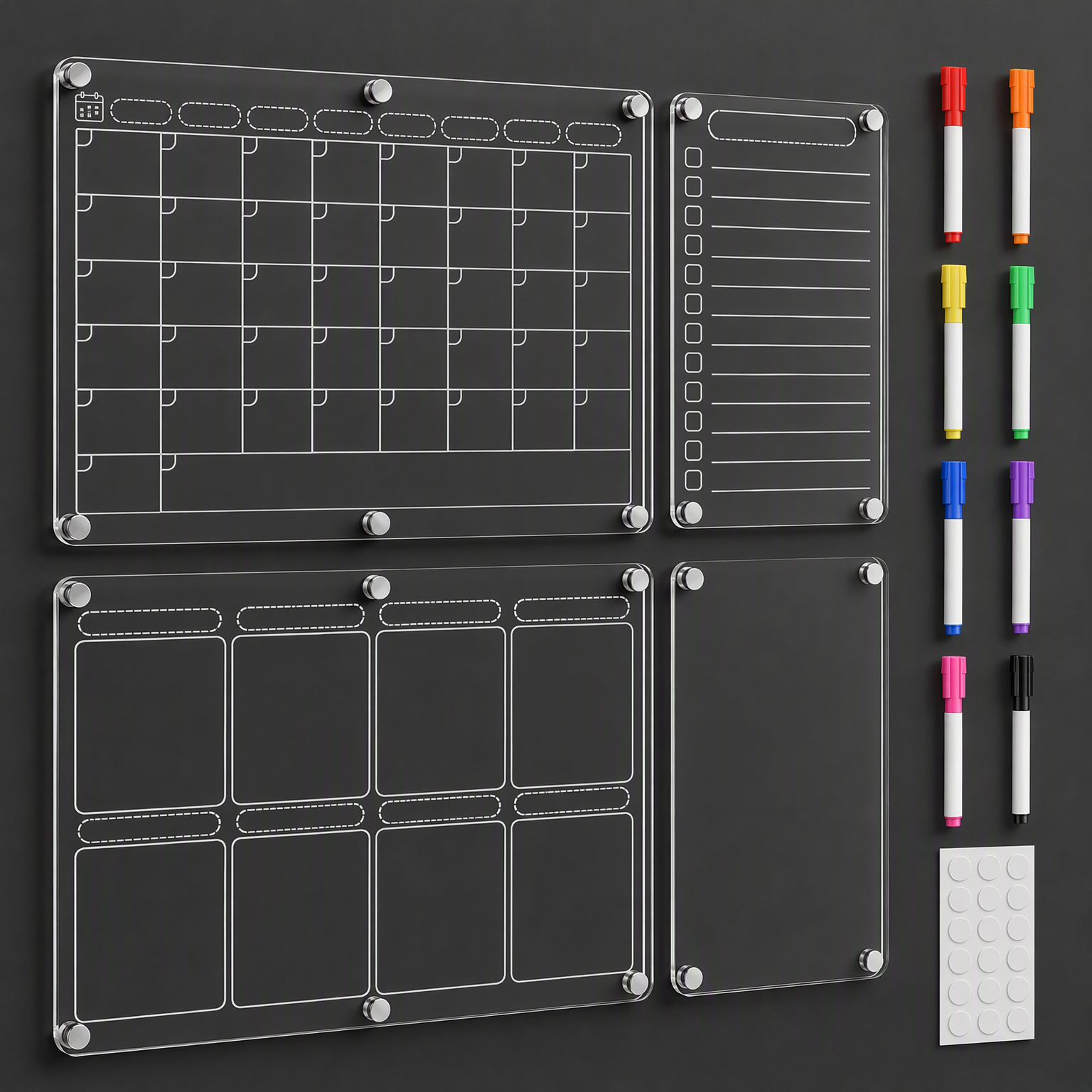
A monthly planner whiteboard makes the month visible where decisions happen: on a kitchen fridge, beside a team desk, or in a shared work area. Unlike a paper page hidden in a binder or a calendar tab buried on a screen, an erasable planning board gives everyone a quick view of deadlines, appointments, and routines. The right choice is not automatically the largest board or the layout with the most boxes. It is the one whose writing space, placement, and update rhythm match the way people actually plan.
For retailers, distributors, and B2B buyers, that practical distinction matters. A calendar that looks attractive in a product photo may be difficult to read from across a room, too small for family schedules, or too complex for an office that only needs milestone tracking. This guide compares the most useful styles and provides a selection framework for a monthly planner whiteboard range.
Digital calendars are excellent for alerts, recurring events, and personal detail. Paper calendars can feel satisfying and portable. A monthly planner whiteboard fills a different role: it is a shared visual control point. A household can see school dates and meal plans at a glance; a small office can see handoffs and launch dates without opening an app; a retail team can post promotions or replenishment tasks where the shift can see them.
The value is strongest when the board has a defined audience and a fixed home. If one person updates a detailed schedule several times a day, a digital tool may remain the source of truth. If several people need a fast, low-friction view of the month, an erasable board is often easier to notice and discuss. That boundary is important—visible planning is most effective when visibility, not data storage, is the main problem to solve.
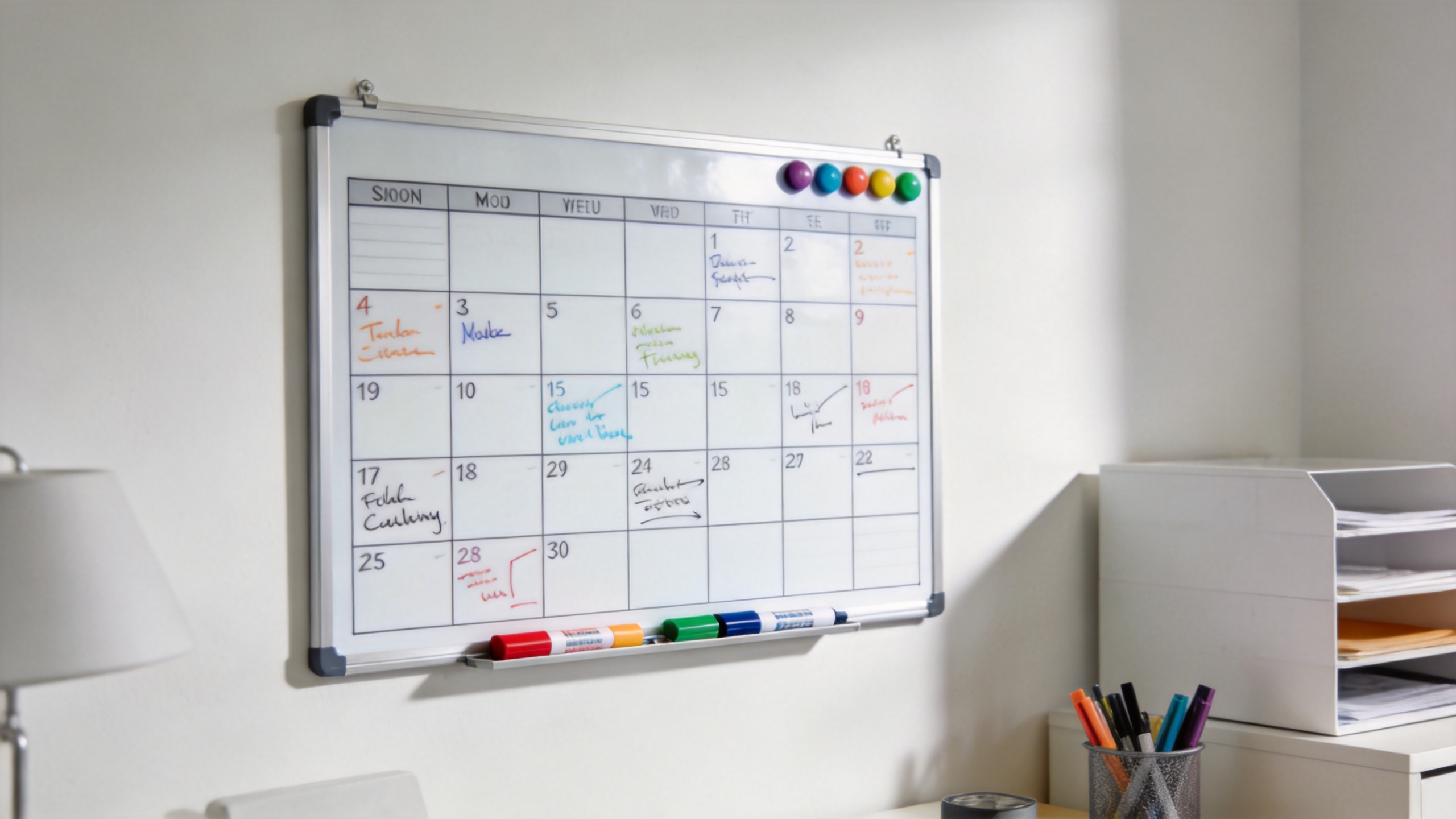
A monthly grid is the familiar choice for homes, classrooms, reception areas, and project teams. Each day receives its own box, which makes it easy to scan dates and identify busy periods. Look closely at the usable writing area inside each square rather than judging the overall board dimensions alone. A compact magnetic fridge calendar may suit short reminders, while a wall-mounted monthly planner whiteboard needs larger cells for multiple names, tasks, or time windows.
Some users need both the long view and the next-action view. A monthly overview shows dates, while a weekly section handles appointments, to-dos, and priorities. This format is useful for families, service teams, and students because it prevents the monthly grid from becoming overly crowded. The trade-off is that each area is smaller. Before buying, decide whether the board is primarily for scheduling dates or for assigning daily work.
Undated layouts can reduce waste when planning is seasonal or intermittent. They also make sense for a reusable calendar kept on a refrigerator, in a meeting room, or in a temporary project space. An undated monthly planner whiteboard lets the user start at any time, but it needs clear month and weekday labels to avoid confusion. For retail assortments, reusable formats can complement dated paper planners rather than replace them.
Larger boards are better for groups, but size should follow the viewing distance and the amount of handwriting required. A 120 x 90 whiteboard can be a practical option when a team needs a broad month view, color-coded assignments, and room for notes. It may be excessive for a narrow hallway or small apartment kitchen. Likewise, a 3x4 whiteboard can work well for a compact office calendar, a classroom station, or a task board when the cell layout remains legible.
| Use case | Useful format | What to check |
|---|---|---|
| Family kitchen | Magnetic monthly or monthly-plus-weekly planner | Fridge fit, room for names, marker storage, quick cleanup |
| Small office | Wall calendar with notes or task section | Viewing distance, meeting cadence, wall position, readable cells |
| Retail or service counter | Simple monthly overview | Fast updates, shift visibility, durable surface, visual clarity |
| Distributor or B2B project | Large customized planner board | Standardized dimensions, branding, packaging, replenishment needs |
Measure the placement area first, including clearance for doors or cabinet handles. Then estimate the longest entry that must fit in one date cell. That simple exercise often changes the decision. A board can be physically large yet functionally small if its layout gives only narrow writing boxes. In shared environments, leave enough blank space for changes instead of filling every cell on day one.
Magnetic planner boards are convenient where a compatible metal surface is already available, especially for fridge use. Wall-mounted boards may be a better choice when the planning display needs a permanent, eye-level location. Verify the intended mounting method and surface compatibility before committing to a range; magnetism, adhesive options, and hardware requirements should not be assumed from a general product category.
Color is another decision with a practical side. A blue dry erase board can help a display stand out in a coordinated retail or office setting, but contrast still determines readability. Light writing areas and clearly differentiated grid lines are usually easier to use for dense schedules than a decorative background. If the board will be used under bright lighting, request a sample or review the surface finish for glare and marker visibility rather than treating color as a purely aesthetic choice.
For a distributor, the question is not simply which planner is most suitable. It is which assortment can serve different spaces without creating unnecessary SKU complexity. Start with a small format ladder: a fridge-ready option, a mid-size wall option, and a larger team-planning option. Standardizing common marker colors, packaging logic, and basic layout conventions can make replenishment easier for customers and for your own operations.
Customization may be appropriate when the product supports a defined audience: branded headers, a tailored grid, a language-specific weekday format, or packaging developed for a private-label range. These choices should be confirmed with the manufacturer during the OEM or ODM discussion, including artwork requirements, minimum order expectations, lead-time planning, and any material or performance specifications relevant to the intended market. Do not promise a feature simply because another whiteboard product has it.
For product exploration, the CMS-confirmed range includes a Weekly Planner Magnetic Board Dry Erase Monthly Planner Whiteboard for Fridge, a Reusable Magnetic Fridge Calendar Monthly & Weekly Planner with Dry Erase Markers for Kitchen Organization, and a Reusable Silicone Calendar Removable Weekly and Monthly Planner with To-Do List for Office and Home Use Whiteboard Genre. Use their confirmed titles and product pages as a starting point, then validate fit for the target market and requested format.
Good maintenance is simple but should follow the supplier’s instructions for the specific surface. Erase routine notes regularly rather than allowing marker residue to remain for long periods. Use a clean, soft eraser or cloth, and test any deeper-cleaning method in an inconspicuous area first. Purpose-made whiteboard cleaners and isopropyl-alcohol-based approaches are commonly discussed for dry-erase care, but product guidance takes priority because coatings and printed calendar areas can differ.
Assign a place for markers and an eraser, and keep permanent markers away from the planner area. In busy households or offices, a short reset at the end of each month prevents old tasks from becoming visual noise. In other words, the board is most useful when its maintenance rhythm is part of the planning rhythm.
A suitable monthly planner whiteboard is therefore a fit decision, not a one-size-fits-all purchase. Start with who needs to see it, what they need to write, and where the board will live. From there, the right format and style become much easier to identify—and the planner is more likely to remain useful after the first busy month.

2026/08/20
Unlock flexible, repositionable whiteboarding for education, agile offices, retail, healthcare & more. Cuttable, magnetic, certified — request your free B2B sample today.

2026/10/10
Discover the 2027 Texture Magnetic Collection & Exclusive Exhibition Promotions Dear Global Partners and Valued Clients, We are thrilled to announce that Shenzhen U&U Magnetic Technology Co., Ltd. (Brand: UCMD) will be officially exhibiting...

2026/08/19
Discover how UCMD® leverages the Canton Fair to showcase magnetic educational & lifestyle products, build global buyer trust, and drive OEM/ODM partnerships. Explore our certified, customizable solutions today.

2026/08/28
Our Commitment to People, Planet & IntegrityAt ShenZhen U&U Magnetic Technology Co., Ltd. (UCMD®), we believe that how we make our products matters as much as what we make. From our factory floor in Shenzhen's Bao An District to the hands...

Please tell us about your company's advantages and characteristics.

Please tell us about your company's advantages and characteristics.

Please tell us about your company's advantages and characteristics.

Please tell us about your company's advantages and characteristics.

Please tell us about your company's advantages and characteristics.

Please tell us about your company's advantages and characteristics.

