 EN

Magnetic Whiteboards for Offices
Please tell us about your company's advantages and characteristics.
2026/09/03
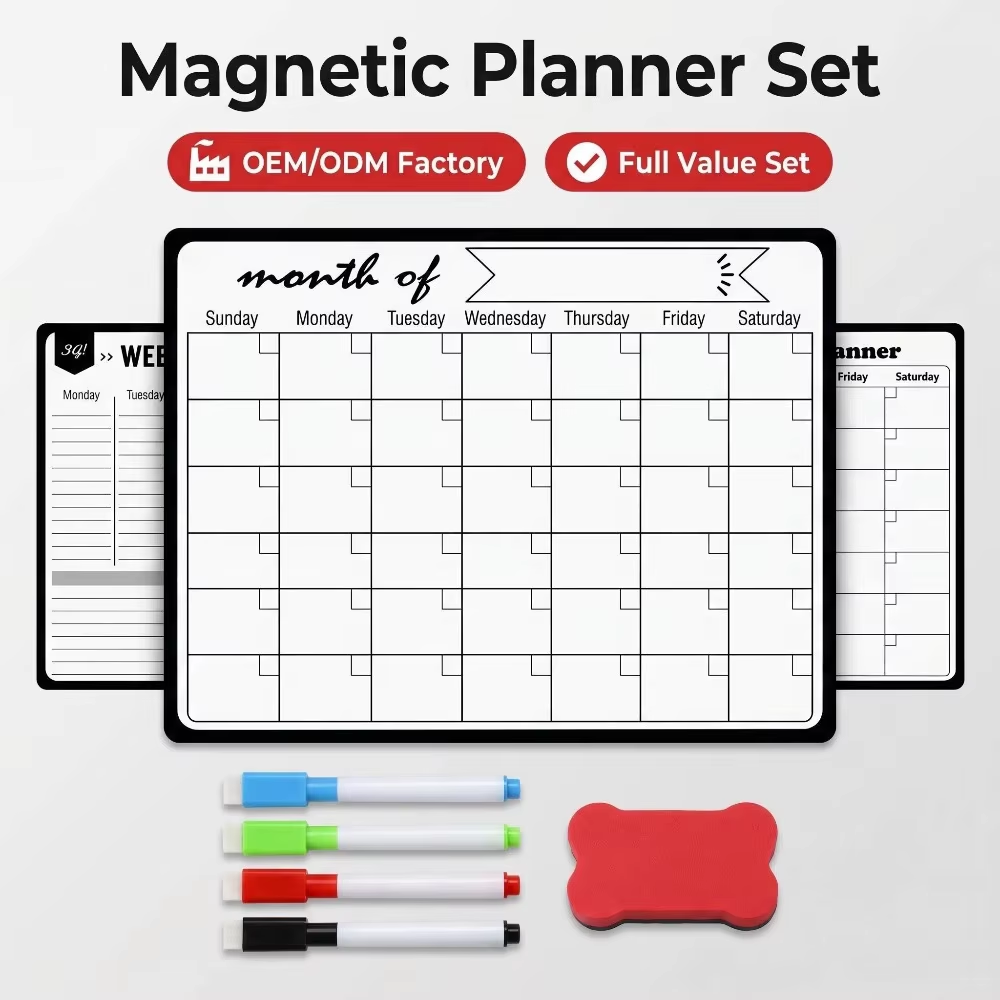
A six-doctor clinic in Bristol ran appointment planning on a shared desk planner for years and lost time every morning to the same question: who had changed what. The practice manager moved the schedule to a wall-mounted dry erase calendar for wall use in the reception corridor, where staff, locums and cleaners all pass. A year on, the morning huddle is shorter, because the plan is visible to everyone who needs it without a login, and nobody has to ask which version is current.
The clinic chose a framed steel panel, 90 by 60 cm, mounted with a French cleat at 145 cm to the centre. Anyone passing can read it; nobody can knock it off a desk. A dry erase calendar for wall mounting works here because the corridor is the one route every member of staff walks several times a day. The practice also keeps a second dry erase calendar for wall use in the staff room, so the two panels never carry conflicting information.
Three problems show up repeatedly. Panels are mounted too high for shorter staff to write on the top row. Fixings are chosen for the wall covering rather than the substrate, so the panel pulls out of plasterboard under its own weight. And the surface is specified for a meeting room, not for daily rewriting, so it ghosts within a term. A dry erase calendar for wall mounting also fails when it is placed where direct sun hits it for part of the day, fading both print and ink. Lighting is the quiet failure. A panel directly opposite a window turns into a mirror for part of the day, and staff stop using it rather than complain. Check the sightline at the time of day the room is busiest before fixing the position.
Melamine on a fibreboard core is the lowest-cost and the shortest-lived; it stains within a year of daily use. Painted steel adds magnet receptivity, which matters if the panel also carries notes. Glass is the most resistant to staining and the heaviest, and it needs a steel backing layer to accept magnets. Peel-and-stick film turns any smooth painted surface into a planner, but it cannot be repositioned once the adhesive grabs. Weight is the deciding factor for renters, who usually want a dry erase calendar for wall fixing that leaves no holes at all.
A French cleat spreads load across two or more studs and is the safest option for panels above 5 kg. Standoff fixings suit glass, distributing weight across four points. For plasterboard without a stud behind the intended position, use spring toggles rated well above the panel weight; for masonry, use sleeve anchors. Where magnets are needed, a steel-faced dry erase calendar for wall installations is the only one of the four that holds notes without a separate rail. Renters and listed buildings often cannot fix into structure at all. In those cases the cleat is replaced by a high-bond tape system or a removable adhesive sheet, both of which need a sound, fully cured painted surface and a panel light enough to stay put. A dry erase calendar for wall use on tape should be limited to melamine or thin steel, since glass is too heavy for adhesive fixing.
Drilling into a wall risks hitting cables and pipework. NFPA 70, the National Electrical Code, sets the rules for cable protection inside walls, which is why any fixing that penetrates deeper than the plaster should be checked with a detector first. Dry-erase markers sold in the US fall under the Labeling of Hazardous Art Materials Act, assessed against ASTM D4236, so markers supplied with a dry erase calendar for wall use should carry that statement. Any dry erase calendar for wall mounting in a school or clinic should also be checked against ASTM E84 for surface burning characteristics. REACH and RoHS cover the film, inks and frame coatings, and EN 71-3 applies where children will use the panel.
Start with the wall: substrate, stud spacing and any services behind it. Then set the size from writing rows, not from available space. Decide whether the panel needs to accept magnets, because that single question rules melamine out. Ask the supplier for coating type, substrate, frame material and fixing hardware, and confirm that a dry erase calendar for wall use in a busy corridor has a matte rather than glossy top coat. Where the panel may need to move later, choose a dry erase calendar for wall fixing with a cleat rather than adhesive.
Wipe the panel weekly with a dedicated cleaner and a microfibre cloth; all-purpose sprays leave a film that causes ghosting. Avoid abrasive pads, which scratch the coating permanently. Re-torque fixings every six months, and replace a dry erase calendar for wall service once erased text stops coming off cleanly, since a panel nobody can read is worse than an empty wall. Marker storage matters more than most buyers expect. Caps left off for an hour ruin a marker, and a board with no working pens stops being updated within a week. Keep a clipped set beside the panel and check it during the weekly clean, replacing anything that has gone dry. U&U Magnetic Technology supplies magnetic panels and planners under ISO 9001 with REACH and RoHS documentation.
A dry erase calendar for wall use needs a smooth, rigid surface: painted steel, glass or a framed melamine panel all work. Avoid applying film directly to rough plaster or textured wallpaper, since the film takes the texture and stays hard to erase. Mount a proper panel instead.
Hang a dry erase calendar for wall use with the centre around 140 to 150 cm from the floor, so most adults can reach every row. Check the top row against the shortest regular user rather than the tallest. In schools and accessible spaces, confirm local reach-range rules before fixing.
Yes, but fix into studs or use spring toggles rated well above the panel weight. A dry erase calendar for wall mounting must never hang on plaster skim alone. A French cleat across two studs is the safest method for anything above 5 kg, and it also makes the panel easy to lift off.
No. Only steel-faced panels accept magnets. Melamine and glass boards need a steel backing layer, and a dry erase calendar for wall duty that must hold notes should be specified as painted steel. Glass with a steel interlayer holds magnets, but with noticeably reduced force.
Fine-point, low-odour markers suit daily writing, and chisel tips suit headings. In the US, markers should carry an ASTM D4236 statement under the Labeling of Hazardous Art Materials Act. Replace caps promptly, since a dried marker is the most common reason a dry erase calendar for wall use stops being updated.
Wipe a dry erase calendar for wall mounting weekly with a dedicated cleaner and a microfibre cloth. Daily rewriting builds a solvent film that causes ghosting, so light regular cleaning prevents heavy scrubbing. Avoid abrasive pads, which scratch the coating permanently and make later cleaning harder.

2026/08/20
Unlock flexible, repositionable whiteboarding for education, agile offices, retail, healthcare & more. Cuttable, magnetic, certified — request your free B2B sample today.

2026/10/10
Discover the 2027 Texture Magnetic Collection & Exclusive Exhibition Promotions Dear Global Partners and Valued Clients, We are thrilled to announce that Shenzhen U&U Magnetic Technology Co., Ltd. (Brand: UCMD) will be officially exhibiting...

2026/08/19
Discover how UCMD® leverages the Canton Fair to showcase magnetic educational & lifestyle products, build global buyer trust, and drive OEM/ODM partnerships. Explore our certified, customizable solutions today.

2026/08/28
Our Commitment to People, Planet & IntegrityAt ShenZhen U&U Magnetic Technology Co., Ltd. (UCMD®), we believe that how we make our products matters as much as what we make. From our factory floor in Shenzhen's Bao An District to the hands...

Please tell us about your company's advantages and characteristics.

Please tell us about your company's advantages and characteristics.

Please tell us about your company's advantages and characteristics.

Please tell us about your company's advantages and characteristics.

Please tell us about your company's advantages and characteristics.

Please tell us about your company's advantages and characteristics.

